It all begins with the sheep.
Our Earlybird Winter Discovery Guide’s fourth book, A New coat for Anna by Harriet Ziefert is a sweet story that helps readers learn just where a wool coat actually comes from.
It all begins with the sheep.
Our Earlybird Winter Discovery Guide’s fourth book, A New coat for Anna by Harriet Ziefert is a sweet story that helps readers learn just where a wool coat actually comes from.
Where I live there are NEVER snow days (sad face).
But there is ALWAYS white paint!
For this icy, project I decided to introduce the art of Jasper Johns to inspire my apprentice artists. I'm hoping to inspire yours too. We mad a really large, collaborative piece, but this would translate well into an individual work quite nicely. To begin, have your students gather a dozen or more really wonderful, extravagant words—a lexicon for winter.
You will need to gather the following supplies before you begin:
One large sheet of Cardboard (this one is 2' x 3').
A basket of assorted wood, cardboard, or sticker letters, many sizes and many different fonts.
One good pair of sharp scissors (we also used a heavy-duty paper cutter).
One hot glue gun with a large supply of glue.
A large quantity of white acrylic paint and a large paint brush.
Begin with the background, Create geometry using a random, collage technique, layering shapes on top of each other and glueing them to the background using the hot glue gun. When you are satisfied with the background, begin glueing down the words but it is a good idea to lay them all out before glueing to make sure you are satisfied with the placement. Mix and match type-faces, try placing words sideways and upside down. When the cardboard collaging is complete, the fun begins. Slather on a first layer of white paint. Let the coat dry completely then layer on a second coat, and a third! The trick to a really fun end result is to be courageously spontaneous while layering. When you think your done, keep going! Keep layering until the work of art feels snowed in. The you will know its winter.
-Kim
Our Earlybird Winter Literature and Writing Discovery Guide's third book, The Mitten by Alvin Tresselt is re-telling of a folk tale about all kinds of animals trying to fit in a lost mitten! Hilarious! We love the theme that common needs can bring people together.
You can carry this theme forward by reading, Unlikely Friendships: 47 remarkable stories from the Animal Kingdom by Jennifer S. Holland.
If this book doesn’t elicit a mitten-full of “Oh, that is soooo cute!," we don’t know what will!
-Sara
When my oldest son was a toddler, I watched him make his way toward our back yard fence toward a knothole. I watched to see what he would do. Funny thing, he just stood there. He stood there for the longest time in the silence of mid-morning. I wondered what my son was seeing. I wondered about the other side of the fence. So I tiptoed into the house, grabbed my film camera and made my way to the other side of the fence.
This is the face of wonderment.
So her's to wonderment. Find a knothole. Have a look see.
Kim

What better way to learn about courage than from a character in a book!
Our Earlybird Winter Literature and Writing and Discovery Guide features Brave Irene by William Steig. Irene demonstrates love and courage by helping her sick mother in the dead of winter deliver an important package.
We love stories that highlight girl heroines! For more on this theme, a fun read aloud might be Elizabeth Blackwell: Girl Doctor (Childhood of famous Americans).
Keep the conversation going. What does it mean to be brave?
-Sara
For an interdisciplinary approach to literature, dive into our Winter Earlybird Literature Discovery Guide that features an eclectic mix of wonderfully told stories. It begins with Snowballs by Lois Ehlert, where your child will discover the wonders of the water cycle and how snow comes into being.
Did you know that you can watch the water cycle water cycle in a ziplock bag? For best results, make sure you hang it in a sunny window. We'd love to hear what you discover.
To extend the fun, read All the Water in the World by George Ella Lyon
-Sara
Sparkle! And while you are at it sparkle and spin. Add capital letters to that phrase and you've got one bling-of-a-book!
Sparkle and Spin: A Book About Words by Ann Rand and Paul Rand is a mid-century treasure that I hope will oscillate its way into the heart of 21st century readers. Here words sparkle their images and spin their sounds and leave readers happy about the art of words. What better way to remind little and big alike that some words add sparkle to language?
-Kim
Ready or not… Here come the holidays!
Give the gift of bones.
Not real bones.
Put together a kit containing Qtips, a bottle of white glue, a stack of assorted handcrafted pre-cut imaginary dinosaur skulls, and a stack of black construction paper. Make a sample to put in the kit. And be sure to include a book or two. Here are some ideas recommended by the Smithsonian and others:
-Kim
I've never understood apple pie and cheddar cheese.
For me it's apple pie and books.
One day, after a long walk, John sat under a tree to rest—an apple tree, of course. What better way to begin pie making than reading about John Chapman, the nurseryman who seeded much of our landscape with apples. From there, my recipe calls for Apple Picking Time by Michele Benoit Slawson about a girl named Anna who cares deeply about the tradition of gathering apples from those trees that Johnnie Appleseed so carefully cultivated. But it's still not time to go to the pantry. Not yet…
My recipe calls for How to Make an Apple Pie and See the World by Marjorie Pirceman. An apple is easy to gather from the market, but where did that apple come from? And the butter? The sugar? The spices? The answers call for a journey. And this little story guides the way.
Once back…
N o w it's time to go to the pantry. Peel some apples, remove the cores, and slice. Add a sprinkle fresh lemon juice to enhance the apple tang. Toss with sugar, cinnamon for spice, cardamom for warmth, and a happy pinch of nutmeg. Set aside. Cut the butter into the flour until the butter makes the flour sandy. Add water to the flour mixture, form a ball, then roll the top and bottom crusts. Fill the bottom crust with prepared apples, cover it with the top crust and crimp. Bake. Enjoy.
Nothing like apple pie and books.
-Kim
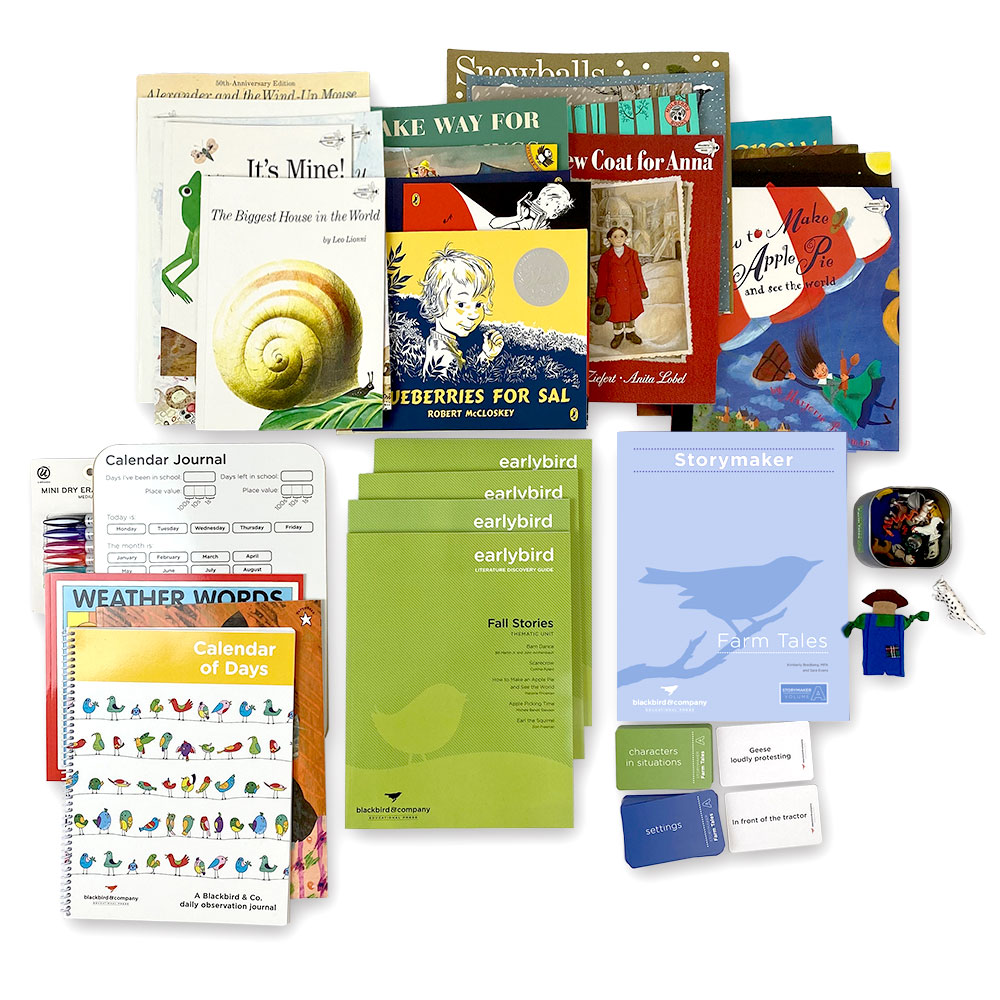
I love fall. I love the sights. I love the scents. I love the texture of leaves crunching beneath my feet. I love the snap of ripe apples being twisted from branches.
And I love the stories of fall. With my youngest, Søren, I worked through our Earlybird Fall Literature and Discovery Guide three times (once at the beginning of kindergarten, once at the beginning of first grade, and once at the beginning of second grade)! Count them, three.I'm totally serious.
Three is an important number.
There is so much happening intellectually in the primary years—Kindergarten, First, and Second Grade. These first three years of school are when children are learning the basics of reading (decoding) and writing (encoding).
My son the kindergartener loved stories and he loved to draw. Copying words became an extension of this fun. We would read the stories together and chat our way through character descriptions. I used a hand-held whiteboard to capture his ideas so he could happily copy them as art into his journal. We enjoyed a fall craft each week, that was a given. When we read, How to see an Apple Pie and See the World, we made miniature apple pies. When we read the Scarecrow, we made a scarecrow doll. When we read Apple Picking Time, we drove for two hours to pick apples, taste apples, and after that, we made apple prints.
The second year, and the third after that, when I brought out the books, my son did not groan. My son was delighted to see his seasonal friends! The only thing that changed during these second and third passes was that my son was able to utilize his knowledge of language so far to encode his own ideas with me by his side. When we talked about the characters in Apple Picking Time, he was able to write a single words like "brv" for brave, and "frind" for friend to describe Anna. He was able to complete sentences from the word bank on his own. His journal time became an independent exercise too. We expanded our crafts to include a full-sized scarecrow, but we still made our traditional mini-apple pie.
During our third, and final pass at the unit at the beginning of 2nd Grade, Soren came loaded with ideas, "Mom, when we read Barn Dance, can I make the characters out of Legos? And when it came time for apple pie, he peeled and cut the apples on his own (with me hovering close by), measured the flour (dusting the kitchen with twice as much required for the recipe), and rolled the dough "all by himself" (for the most part). That year character descriptions included a deeper ingrained knowledge of phonics—friend was at last "friend" and "brave" was at last brave"—and a peaceful sense of independence. I knew that this would be the last fall we would work through the guide. Third grade would bring a new adventure with our Level 1 guides.
Soren did not work through any other Earlybird selection more than once. But he did work through them ALL during the primary years (kindergarten and 2nd grade). And I'm so glad he did. He worked through Level 1, Level 2, Level 3, and Level 4 too!
My son is now seventeen, and, looking back, I can say with certainty that it took all those years for him to develop and percolate his reading and writing skills. Literacy is an immensely complex, nuanced art. This year Søren is a high school junior interested in philosophy reading the likes of Kierkegaard (his namesake), Hobbs and Locke and Whitman. Who would have known back when we were picking apples? But I have no doubt in my mind that he is able to wake through the work of these wordsmiths because of the traditions we began back in kindergarten.
I am convinced that the longitude of utilizing our approach—the Blackbird & Co. approach—gave him the stamina and the skills to think deeply about great books and to formulate original, well-versed culminating ideas.
It's still fall. Why not begin today? Snap an apple off the tree. The harvest season is small and precious.
-Kim